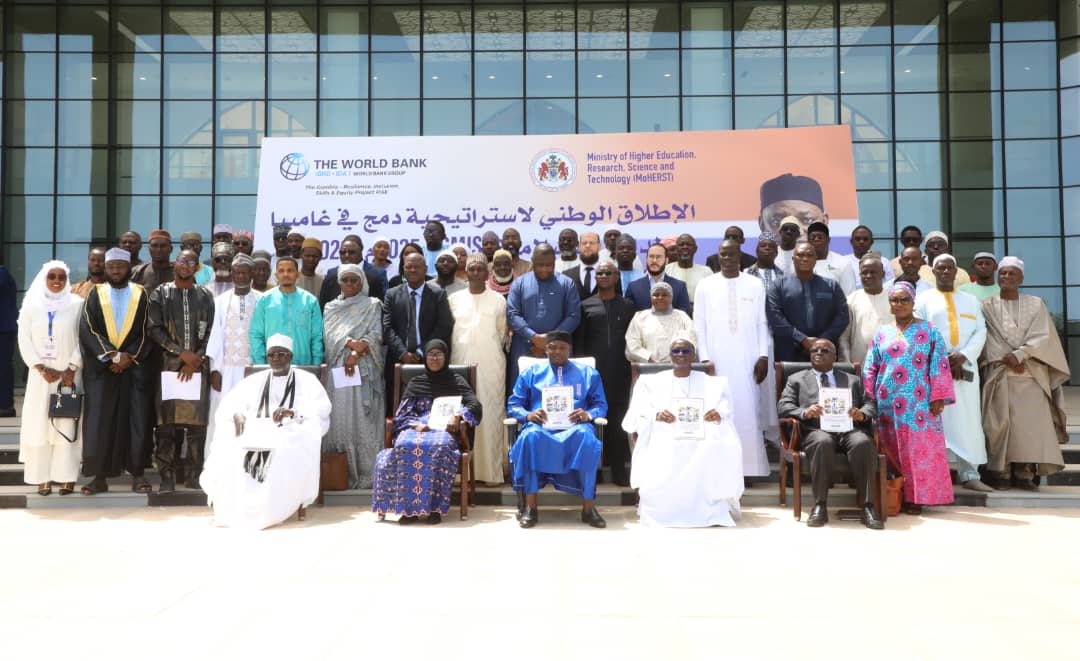
Held on Tuesday, 10 June 2025 at The SDKJ International Conference Centre
Thank you, Moderator, for your introductory remarks.
Honourable Speaker of the National Assembly, My Lord, the Honourable Chief Justice, Honourable Cabinet Ministers, Members of the Diplomatic and Consular Corps, Senior Government Officials and Service Chiefs, Religious and Traditional Leaders, Representatives of the World Bank and other Development Partners, National and International Stakeholders in Education, Representatives of Civil Society and the Private Sector, Distinguished Guests, The Media, Ladies and Gentlemen,
It is with immense joy and a deep sense of pride that I preside over the launch of the Gambia Madrassah Integration Strategy (GMIS) 2025-2029. This landmark event is in sync with my government’s strong determination to provide inclusive and equitable education for every Gambian, regardless of any form of distinction.
For generations, the parallel Madrassah and Majalis education systems have played an integral role in influencing and shaping the moral, spiritual, and academic fabric of our society.
Today, we are acknowledging their historical contributions and charting a future where these institutions will be fully integrated into the country’s national education architecture.
The moment, therefore, is not only a policy milestone but also a powerful statement of our collective commitment to equity, inclusion, and transformation of The Gambia’s education system.
It reflects the belief that every Gambian child deserves an equal opportunity to pursue tertiary and higher education, gain valuable skills, and contribute meaningfully to the nation's socio-economic growth and development.
Ladies and Gentlemen,
Despite their moral grounding, discipline, and academic excellence, our Madrassah graduates have, for far too long, faced systemic barriers in transitioning to post-secondary education. Mostly, these barriers relate to limited English language proficiency, lack of access to specialised skills development opportunities, curriculum issues, and inaccessible pathways to tertiary and higher education. Such barriers have inhibited the potential of a significant portion of our youth, many of whom come from economically and socially marginalised communities. We should endeavour to break down such discriminatory barriers.
The GMIS Strategy, developed through broad consultations and rigorous analysis, seeks to change this narrative. It offers a transformative roadmap with strategic pillars on resource mobilisation and sustainability, governance and advocacy, information and communication, infrastructure development, project management and, of course, capacity development.
Through these pillars, the GMIS aims to mainstream Madrassah education into our national development agenda and to ensure that graduates are empowered with the skills, qualifications, and opportunities they need to succeed.
Excellencies, Distinguished Guests,
The Gambia Madrassah Integration Strategy is aligned with both national and international frameworks, such as our National Development Plan (NDP 2023–2027), the Sustainable Development Goal on inclusive and equitable quality education, The African Union 2063 Agenda, and UNESCO’s Global Education Strategy.
This approach is initiated to build a harmonised, culturally responsive, and progressive education system. With this strategy, we will implement bridging programmes for language and STEM literacy, provide TVET and apprenticeship tracks for Madrassah graduates, reform the curriculum and teaching approaches, strengthen institutional partnerships, and invest in the dignity and potential of every student.
Ladies and Gentlemen,
In launching the GMIS and unveiling a strategy, we are opening invaluable opportunities to thousands of young people across the country. We are demonstrating and telling them that their dreams matter, their efforts count, and their future is our shared responsibility.
I thank all our development partners for their continued support, with special thanks conveyed to the World Bank for funding the development of this Madrassah Strategy through the RISE Project.
I now call on all of you to join us in actualising the investment opportunities outlined in the GMIS, from supporting infrastructure development and teacher training to scholarships and technical assistance.
Let me impress upon you, the religious and community leaders, that your guidance is priceless. We count on your voice to help foster understanding, build trust, and promote this integration effort.
To the Ministry of Higher Education, Research, Science and Technology leadership and all those involved in developing this strategy, we register our appreciation and commendation. You have made us proud, but we entreat you to redouble your efforts and bring this vision to fruition.
In conclusion, let this launch mark the beginning of a new era: an era in which “no student is left behind” and wherein diversity in education is a source of strength and every child in The Gambia has a chance to succeed.
On this high note, I officially launch The Gambia Madrassah Integration Strategy 2025–2029. May God bless us all and bless The Gambia.
Thank you for your attention.