Date: 23rd December 2025
The Minister of Environment, Climate Change and Natural Resources and other Honourable Ministers present,
The World Bank Resident Representative and other members of the Diplomatic and Consular Corps,
Development Partners,
Country Representative of the International Trade Centre,
Senior Public Officials,
Honourable National Assembly Members,
Honourable Ward Councillors,
Community Members from the Project Intervention Area,
Staff of the Ministry of Environment, Climate Change and Natural Resources,
The WACA Project Team,
Distinguished Guests,
Members of the Media,
Ladies and Gentlemen,
In 2022, during the devastating floods that killed several people, displaced thousands, and disrupted lives across our country, I visited some of the affected communities and promised that my government would take urgent steps to tackle flooding, especially in densely populated areas.
Less than a year later, we launched the West Africa Coastal Areas (WACA) Resilience Investment Project. This forty-five million US Dollar (US$45 million) groundbreaking initiative is aimed at addressing the threats of flooding and pollution in the Kotu Stream, one of the most vulnerable areas in the Greater Banjul Area.
The project is part of a broader regional initiative, funded by the World Bank to protect and preserve the shared coastal resources of West African nations.
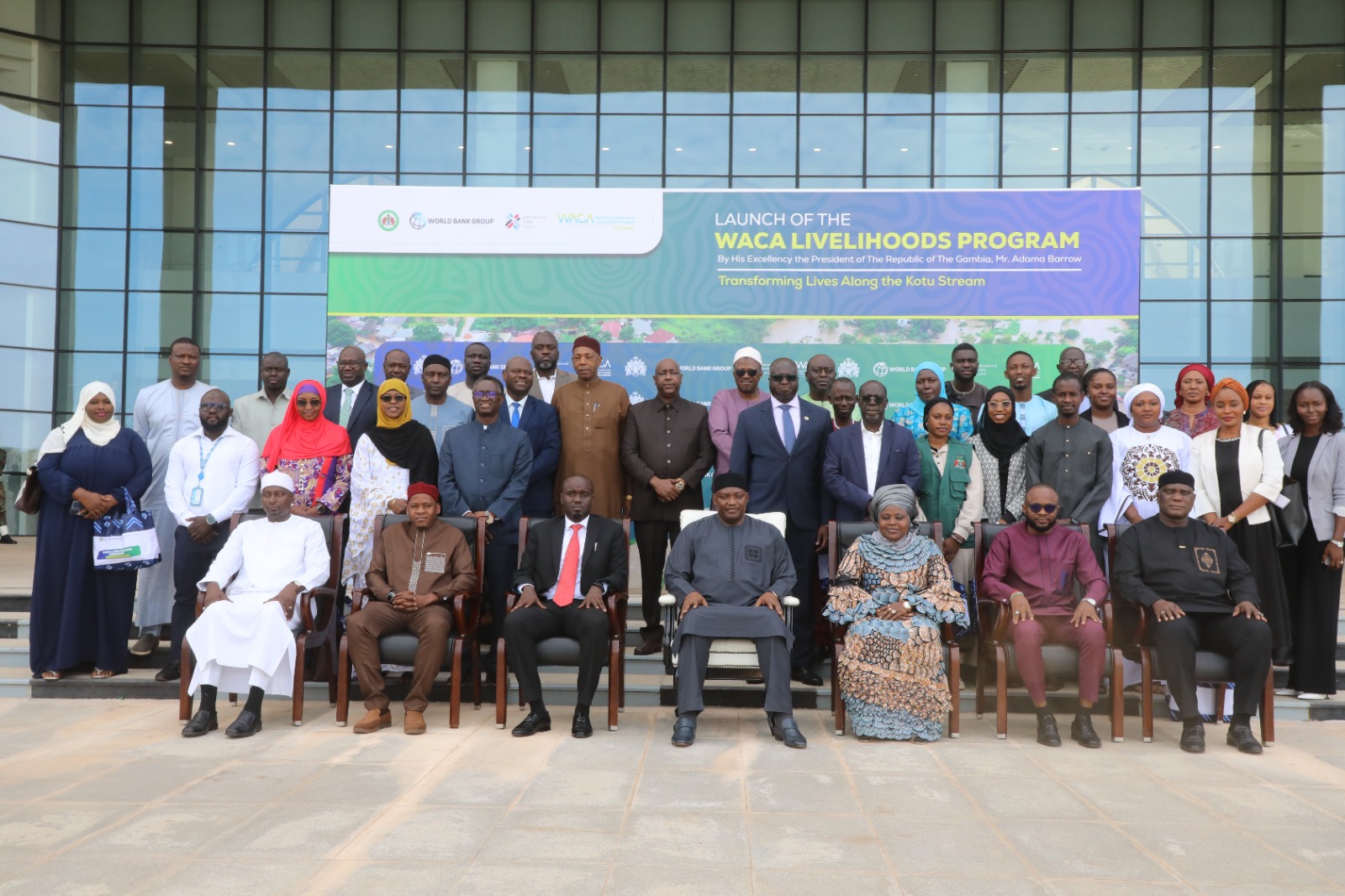
Today, we have cheerfully come together to launch the WACA Project Livelihoods Programme, whose goal is to decisively transform lives and strengthen resilience. With a budget of five million US dollars, the programme will support four thousand (4,000) beneficiaries over the next two years.
The first phase will disburse one million, six hundred thousand US dollars (US$1.6 million) for one thousand, five hundred (1,500) beneficiaries. The target groups are individual enterprises, livelihood groups, farmer-based organisations, and producer groups operating along the Kotu Stream.
The reason for targeting these groups is to protect their livelihoods and stimulate entrepreneurship, food security, and climate adaptation at the grassroots level.
Priority will be given to our women, youths, and persons with disability to build sustainable livelihoods in various areas, such as urban agriculture, tie and dye production, solid waste management, social enterprises, and high-impact industries
Let me take this moment to express my deepest appreciation to the World Bank for funding this transformative project. The World Bank remains a trusted and long-standing partner in our national development journey, for which we are truly grateful.
We are also thankful to the International Trade Centre for partnering with us to deliver this vital programme.
Ladies and Gentlemen,
True resilience requires strong investment in infrastructure and services that protect the lives and dignity of people and empower them to withstand and recover from shocks.
Through this project, we will build the required infrastructure to protect families from flooding and support them to live in dignity.
This approach stems from my government’s social protection system, which seeks to ensure that every Gambian, no matter who they are or where they live, have a fair chance in life.
Additionally, the project is tagged to our commitment to the National Plan - Yiriwa and our vision for a prosperous and climate-resilient economy. Based on this, my administration is consistently making bold and transformative investments to strengthen our institutions and establish national resilience-enhancing policies.
It is satisfying to observe that, within a relatively short period, the WACA Project has supported the development of several landmark legislative and policy instruments. The Gambia’s first-ever Climate Change Bill, the first National Land Policy, the first National Rainwater Harvesting Policy, and the National Disaster Risk Management Policy are examples.
Alongside these are several other environmental regulations and strategic development frameworks for our public institutions. This aside, the project has enhanced the technical capacity of over one (100) government personnel in diverse fields.
It is essential for the beneficiaries of this programme to remember that the opportunities are yours to take. Use them wisely and sustainably to transform your communities for the better.
This scheme is much about financial support as it is about empowerment, resilience, and self-esteem. Its success depends on you, the beneficiaries; therefore, own it and commit to it with diligence and openness.
Because the women and youths are a major driving force in our communities and the backbone of our economy, I am especially pleased that they are central to the project.
Distinguished Ladies and Gentlemen,
Climate change remains one of the greatest challenges of our time. Rising sea levels, coastal erosion, vulnerable livelihoods, and despair have become huge threats to our comfort and survival.
Despite the scale of such threats, let me assure you that my government remains firmly committed to building a Gambia that is resilient, inclusive, and forward-looking. Evidence to show for this is visible countrywide.
This Livelihoods Programme is a generational initiative to lift thousands of vulnerable people out of harm’s way and hardship. Let me confidently add that it is aligned with my government’s broader vision of injecting inclusivity in all national projects.
We encourage all stakeholders, local communities, local authorities, and implementing partners inclusive, to work with the Project team to preserve the Kotu Stream and restore the hopes and dignity of the residents along the Stream.
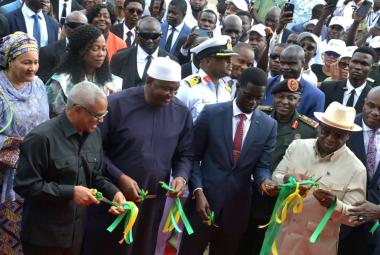
Hoping that we are together in this, it is my singular honour to declare the WACA Project Livelihoods Programme officially launched.
May Allah bless our efforts.