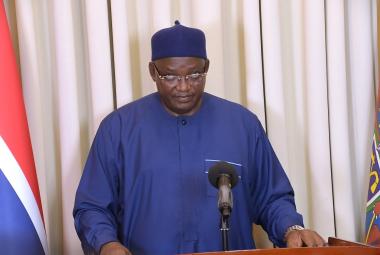
The First Lady, Her Excellency, Mrs Fatoumata Bah-Barrow, The Speaker of the National Assembly, Honourable Minister of Health, Other Cabinet Ministers Present, Secretary to Cabinet and Head of the Civil Service, Chief of Staff, National Assembly Members, Governor and other Local Authorities, The World Bank Group and Other Distinguished Development Partners, Senior and all Government Officials Present, Security Chiefs, Women and Youth Groups, Members of the Press, Ladies and Gentlemen, Less than a month ago, we launched the Food and Drug Lab in Brusubi. All so soon, here we are to celebrate another significant national transformative milestone in the Health sector.
With deep relief and immense pride, we are officially inaugurating The National Emergency Treatment Centre, which houses our new National Reference Lab, the Ministry of Health Training and Conference Centre, the National Diagnostic and Imaging Centre, and the National Biomedical Engineering Unit. These facilities constitute a giant leap forward and reflect our unwavering resolve to improve the health and well-being of every Gambian and resident of The Gambia. With this huge achievement, we have fulfilled a big promise and restored hope and confidence in our healthcare system.
These facilities align directly with the people’s development aspirations and my government’s determination to transform The Gambia into a resilient nation, marked by rapid, inclusive, and sustainable economic growth and development. By investing in advanced healthcare infrastructure of this scale, we are marching head-on towards the establishment of a highly developed nation. It is universally acclaimed that health is wealth. Unless we maintain a healthy population, therefore, we will not maximally utilise the vast potential of the most precious resource of our dear motherland - that is, her beautiful people.
Distinguished Guests, Ladies and Gentlemen, This National Emergency Treatment Centre will significantly strengthen our emergency preparedness and response capacity. It will enhance our ability to manage traumatic cases, pandemic outbreaks, epidemics, and other critical medical conditions requiring rapid, specialised intervention. Modern healthcare depends heavily on timely and accurate diagnostics. This lab will strengthen disease management, improve the timely detection of medical cases, support advanced laboratory investigations, and enhance our ability to respond effectively to emerging health threats. The National Reference Lab is most certainly a ground breaker on our national health security agenda.
Over the years, Gambians struggled to access advanced imaging services, often resulting in delayed diagnosis and treatment. Many travelled for diagnostic services elsewhere. When fully functional, our new National Diagnostic and Imaging Centre will greatly improve access and provide highly specialised diagnostic services for our people. It will enhance early detection, support specialised clinical care, and reduce the need for costly medical travel abroad. Equally important is the Ministry of Health Training and Conference Centre. This component reflects our recognition that infrastructure alone cannot transform healthcare; investing in the people is imperative.
The Training and Conference Centre will strengthen training and continuous professional development for our healthcare workforce and help build a new generation of highly skilled Gambian health professionals. With the sophisticated equipment at hand, we must now do away with bringing in experts to fix our technical challenges. In renewing our pledge to ensure accountability, probity and judicious use of resources, my government decided to establish a National Unit for Biomedical Engineering. This Unit will now function as the servicing centre for all our medical tools. The Minister and Team will work quickly to complete its accreditation and make it available for use by the subregion.
Distinguished Ladies and Gentlemen, These investments have come at a critical time. Like many other countries, The Gambia faces a growing burden of non-communicable diseases. They include hypertension, diabetes, cancer, kidney disease, and cardiovascular conditions. Lessons from the COVID-19 pandemic remind us that resilient health systems are essential not only for health security but also for economic stability, human capital growth, and broader national development.
As part of our long-term national health sector transformation agenda, we expect the progressive expansion of this Farato health complex into a modern national teaching hospital. With its one-thousand-five-hundred-bed capacity, it will operate as the country’s premier centre for specialised healthcare, medical education, research, and innovation.
This future expansion will support advanced specialist and sub-specialist medical services and clinical training, medical research and innovation, expanded intensive care and emergency services, as well as specialised surgical and diagnostic services. This is a potential Centre of Excellence. If realised, it will position The Gambia as a regional hub for quality healthcare and medical training. Future generations of Gambian healthcare personnel will train and practise in world-class facilities right here at home. Happily, also, Gambian families will feel confidently assured of accessible, specialised in-country medical treatment.
Ladies and Gentlemen, Institutions and infrastructure are foundations of dignity. Through our expanded infrastructure development programme, we have demonstrated the essence of focused leadership, especially in transforming dreams and promises into reality and outcomes. Yet, this work has just started. While the centre for kidney transplantation must be completed, the cancer treatment centre has to be built, the Open-Heart Surgery Centre must be operational, and the one-thousand-five-hundred-bed facility must expand. Very crucially, however, we need continuity and stability; so, to successfully finish off the work we have started together, we need your trust and support.
My government remains devoted to further strengthening our healthcare infrastructure nationwide, expanding specialised healthcare services, improving access to medicines, investing in digital health systems, reinforcing the health workforce, and reducing the need for overseas medical referrals. For contributing to the successful completion of this spectacular project, I commend the Minister and his staff, the contractors, consultants, and all other stakeholders. Without hard work, dedication, and sacrifice, this achievement would be unattainable.
I sincerely thank the World Bank for their continued support and partnership in strengthening our health sector. Your partnership and collaboration, Resident Coordinator, continue to significantly contribute to improving the lives of our people. Inspired by this dearly cherished relationship, we are determined to transform our health system into a model for West Africa. I urge the healthcare professionals who will run these facilities to uphold the highest standards of professionalism, compassion, integrity, and patient-centred care. Let the centre emerge as one of enviable excellence, innovation, accountability, and fulfilment for the nation.
Distinguished Guests, Ladies and Gentlemen, As we formally open the doors of this multipurpose centre, I ask that you open the door to a Gambia where we will continue to work collectively and productively. In the same way, let us warmly open our hearts in a Gambia where our health system remains our pride.
Once more, I reaffirm my government’s commitment to building a healthier, stronger, and more prosperous Gambia for all. To this end, I have the honour and pride to declare The Gambia National Emergency Treatment Centre officially open. May Allah continue to bless The Gambia and sustain us in peace, unity, and prosperity. I thank you all.