Speaker of the NA
Honourable Ministers
National Assembly Members
Members of the Diplomatic Corps
World Bank Representative
Representatives of the UN Agency and other international bodies
Regional Governors
Permanent Secretaries, Heads of Departments and Agencies
Civil society Representative
Private sector and Media Representatives
Young Men and Women Present
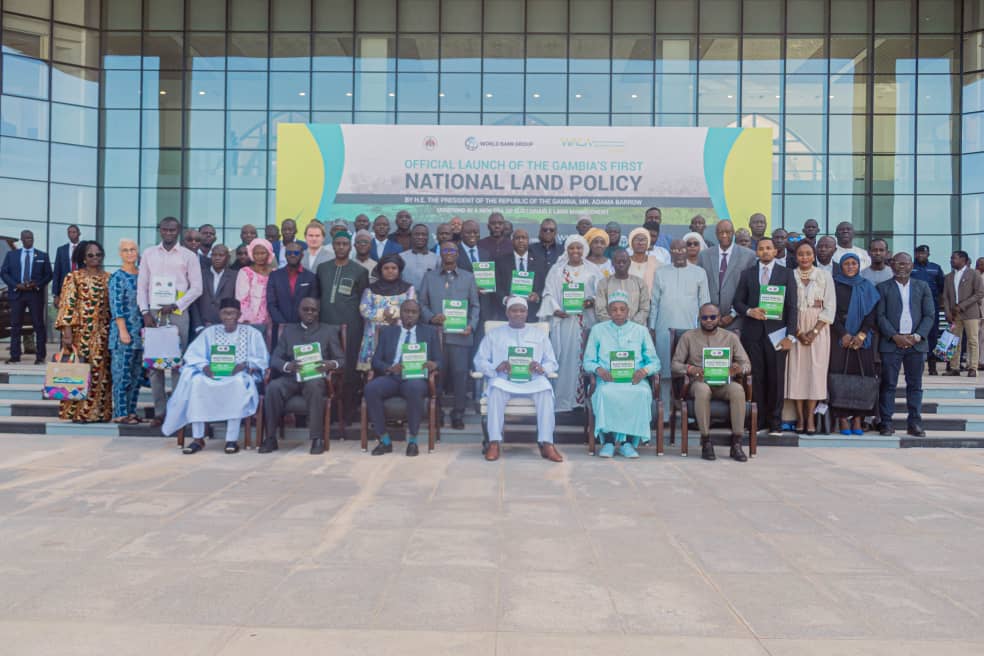
I am pleased to join you today in this august gathering marking the historic launching of the first National Land Policy of The Gambia. I stand here proud that my government has delivered a policy that will guide land sector governance for the next ten years (2026 to 2035.
The formulation of this policy has been a central pillar of my government’s reform agenda, as reflected in my political manifestos and in the Recovery-Focused National Development Plan (2023 to 2027.
Grounded in national development priorities and aligned with international frameworks such as the Sustainable Development Goals, the African Union Framework and Guidelines on Land Policy in Africa, and the Voluntary Guidelines on the Responsible Governance of Tenure, the National Land Policy aims to ensure equitable access, secure tenure, and sustainable land management for all Gambians.
The National Land Policy 2026 to 2035 provides a comprehensive and forward-looking framework to address both longstanding and emerging land governance challenges. It is the country’s first unified land policy, developed through an inclusive, participatory, and consultative process that engaged stakeholders from all regions and sectors.
This policy, which addresses critical land tenure issues as well as broader governance reforms, represents a major achievement for the Government and people of The Gambia. It seeks to improve and strengthen existing land administration systems and legal frameworks by acknowledging the country’s diverse tenure categories.
It also aims to promote a pro-development land use culture and to build institutional capacity to moblise national and international resources for effective implementation. The formulation process was guided by the National Policy Formulation Manual prepared by my office. It was characterised by active and inclusive stakeholder engagement, ensuring no one was left behind. The consultations were intensive, extensive, and exhaustive, aimed at capturing diverse perspectives and fostering national ownership
Distinguished Ladies and Gentlemen,
The National Land Policy identifies transformative policy actions and critical capacity needs that must be addressed. It outlines clear policy statements on the core components of land governance, including access to land and tenure rights, land use planning and regulation, the management of special land issues, land administration structures, land laws, and alignment with the Constitution.
The formulation of this policy was carried out under the leadership of four Technical Working Groups, a National Steering Committee, a Technical Committee, and both national and international consultants.
Distinguished Ladies and Gentlemen,
The policy is organised into seven interrelated chapters on the historical evolution of land governance in The Gambia and the vision, mission, and goals of the policy, which sets guiding principles such as inclusivity, transparency, climate resilience, and respect for human rights.
Additionally, the three land tenure systems in The Gambia: Customary, Freehold, and Leasehold. The reforms also ensure equitable access for women, youth, and persons with disabilities. A national land use plan, integrated spatial development, participatory planning, and digital monitoring systems are all included in the policy. It highlights issues related to informal settlements, environmental sustainability, and the allocation of land for social services and vulnerable groups.
The policy recommends harmonising statutory and customary laws, reforming key legislation to reduce conflicts, strengthen accountability, and build public confidence. It also calls for the establishment of a modern digital National Land Administration System and improved valuation processes, reduced corruption risks, and gender-responsive and climate-resilient administration. Significantly included in the Policy is the creation of a National Land Policy Implementation Unit.
In summary, the National Land Policy 2026 to 2035 is a transformative tool for promoting land justice, strengthening national development, and safeguarding the environment. With effective implementation, it will enhance tenure security, support responsible investment, protect vulnerable populations, and align land governance with national and international standards for peace, prosperity, and sustainable development.
The policy is supported by a comprehensive implementation plan structured in three phases, starting in January 2026. This plan will guide resource mobilisation and cooperation with local and international partners.
I take this opportunity to express our sincere appreciation to the World Bank, through the WACA RESIP 2 Project, for providing full financial support during the formulation process. I also congratulate the Minister of Local Government, the management team, and the consultants whose efforts have made this historic occasion a reality.
I look forward to continued collaboration with all development partners as we work together to implement this important and inclusive policy.